
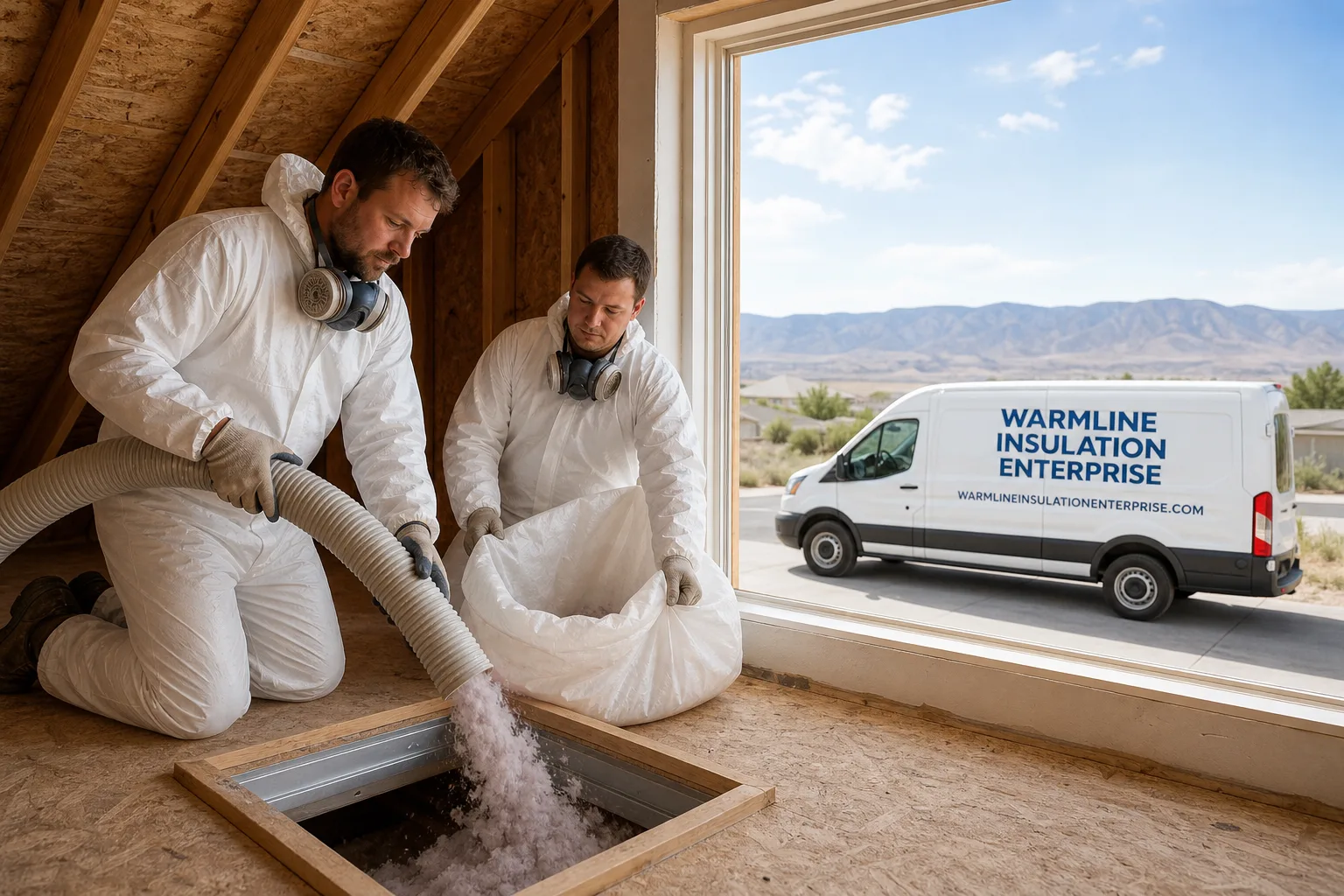
Fast, Reliable Radiant Barrier Installation Across Sandy Valley
If you live in Sandy Valley, you already know what August does to a house. The afternoon sun loads the west side of the roof, the attic turns into an oven, and the back rooms never quite catch up no matter what the thermostat says. We install radiant barriers in Sandy Valley homes built for exactly this problem, and we know the streets from Quartz Road out toward the Sandy Valley Airport. Call (844) 972-1736 and a live person answers, day or night. Most radiant barrier jobs here are finished in a single visit, and every one is covered by our 90-Day Done Right Promise.
Why Warmline Insulation Enterprise Is Sandy Valley’s Preferred Radiant Barrier Installation Company
Sandy Valley homeowners call us back because we treat barrier work as a building-science problem, not a foil sale. We look at the roof exposure, the venting, the existing insulation and the way heat actually moves through your attic before we quote anything. That’s why so many folks out toward Sandy Valley Road and the lower slopes off Cherokee Drive pass our name along.
Our technicians have up to 15 years of experience, and they’re background-checked and uniformed on every Sandy Valley job. We’re licensed and insured, and pricing is quoted upfront before anyone touches your roof. When a Sandy Valley customer refers us, we know we earned it on the last house. The 90-Day Done Right Promise means if the work isn’t right, we make it right.
Response time to Sandy Valley is usually same-day or next-day for estimates, and we schedule around the heat – early starts in summer, because nobody wants to crawl a 150°F attic at 2 in the afternoon. A live person answers the phone around the clock, so you’re never routed through voicemail.
Our Radiant Barrier Installation Services in Sandy Valley
Radiant barrier is one of ten insulation and home-performance services we handle, so we aren’t guessing about the rest of your attic. Our Radiant Barrier Installation team works the same Sandy Valley homes every week, from 1970s wood-frame stucco to manufactured homes and cabins. Here’s how the work breaks down by what your house actually needs.
Attic Radiant Barrier
We staple perforated foil to the underside of the rafters with a proper air gap, keeping the reflective surface off the sheathing so heat doesn’t conduct right through it. In Sandy Valley, this is most often the fix for west-facing attics where the afternoon sun bakes the roof plane and standard fiberglass batts get cooked from above. It also stops those batts from degrading so fast.
Radiant Barrier Foil
For Sandy Valley homes with original uninsulated knee walls and exposed framing, we often pair a foil barrier with rigid board or a closed-cell product like Icynene or Demilec. Foil alone is a smart move when your existing R-value is still decent. When the batts have already sagged, though, the barrier goes on top of a real insulation fix, not over a problem.
Radiant Barrier Roof Deck
On some roof assemblies, deck-mounted barrier is the right call – especially when rafter access is tight on older Sandy Valley homes. We check venting first, because a deck application done without airflow can trap moisture against the sheathing. Foil flat against the deck with no gap is one of the failures we see most, and it’s avoidable.
Radiant Barrier & Ventilation
Many 1970s – 1990s Sandy Valley homes were vented for a milder climate, and those undersized legacy vents let attic temperatures climb past 150°F. We check intake and exhaust venting, upgrade what’s too small for the heat load, then install the barrier so it actually performs. GreenFiber and CertainTeed products round out the insulation side when you need both.
Trusted Brands We Service in Sandy Valley
We work with the insulation industry’s benchmark names – CertainTeed, Icynene, Demilec and GreenFiber among them – and install materials we trust to hold up in high-desert heat. We don’t keep a warehouse or parts yard, so we order what your Sandy Valley job needs and schedule the install, usually within a few days of the estimate. That keeps things moving and keeps the pricing upfront. If a product won’t survive a Sandy Valley summer, we don’t put it in your attic.
Common Radiant Barrier Installation Problems We See in Sandy Valley Homes
We’ve inspected enough Sandy Valley attics to know the mistakes that show up again and again. Here’s what to watch for:
- Foil stapled flat against the roof deck. With no air gap, heat conducts straight through the foil and into the attic – and moisture gets trapped against the sheathing where it can’t dry.
- Barrier installed over sagging, degraded fiberglass. A radiant barrier is a heat-rejection layer, not an insulation substitute. Put it over failing batts and the underlying R-value problem stays right where it was.
- Undersized legacy vents left in place. Sandy Valley homes with vents sized for a milder climate let attic heat spike past 150°F, which defeats the barrier and keeps cooking the insulation below it.
- West-facing attics treated like any other roof plane. The afternoon sun load on that exposure is real, and a barrier designed for it is the difference between comfort and a hot back bedroom all summer.
The West-Facing Problem, Explained
Here’s the local picture. In a typical older Sandy Valley home, a homeowner notices the back rooms are unbearable by mid-afternoon while the front stays tolerable. An attic inspection usually finds bare or settled fiberglass batts under a west-facing roof deck, with vents undersized for the heat load. A qualified local pro air-seals the attic floor, checks and upgrades the venting, then staples a perforated radiant barrier to the underside of the west-side rafters with an air gap – keeping the foil off the deck so neither condensation nor heat transfer gets worse. On homes with original uninsulated knee walls, that barrier work is paired with rigid board or spray foam, because those batts have already lost their R-value.
This is what makes Sandy Valley different from a generic desert retrofit. The west-facing roof planes take the brunt of the afternoon sun, and homes vented for a milder climate cook their own insulation. But the same house faces below-freezing winter nights, so any foil or foam work has to be done without sealing off the venting that lets winter moisture escape. Get that balance wrong in either direction and you trade a hot attic for a wet one. We factor both seasons into every Sandy Valley install.
Pricing for Radiant Barrier Installation in Sandy Valley, NV
Radiant barrier pricing in Sandy Valley runs roughly $1.50 to $2.75 per square foot of treated roof area, so a typical 1,500 to 2,000 square foot attic lands somewhere around $2,000 to $5,000 depending on how much prep the job needs. Ventilation upgrades add $400 to $1,200, and pairing the barrier with insulation work raises the total – but often fixes the actual comfort problem instead of covering it. What moves the number: accessibility, how much old material has to come out, rafter versus deck application, and whether venting is undersized. We give free, upfront estimates and don’t use high-pressure sales. Ask about our standing offers – $50 Off Any Repair Over $250, an $89 Seasonal Tune-Up, and a permanent 5% Senior & Veteran discount.
We Also Serve Cities Near Sandy Valley
Along with Sandy Valley, we handle radiant barrier and insulation work in Enterprise, Spring Valley, Paradise, and Summerlin. If you’re just outside the Sandy Valley area, call and we’ll check whether your address is in our service range. Same live answer, same 90-Day Done Right Promise, same upfront pricing wherever we work.
Serving Sandy Valley, NV – Our Local Coverage Area
We serve Sandy Valley and nearby communities. Use the map below to see the area we cover. If you’re nearby, we can almost certainly help.
FAQs – Radiant Barrier Installation in Sandy Valley
Yes – and in west-facing Sandy Valley attics it’s often the most cost-effective step you can take, because a properly gapped barrier stops the sun from cooking your existing batts. It works best when the batts are still in decent shape and venting is right. If they’ve sagged or lost R-value, we pair the barrier with an insulation fix rather than covering the problem. Call (844) 972-1736 for a free attic inspection.
Because the afternoon sun hits that exposure hardest, and attic temperatures on those roof planes climb past 150°F in summer. East-facing planes see gentler morning sun and don’t carry the same load. We size the barrier and venting to the exposure that’s actually baking your home, so a west-facing Sandy Valley install gets more attention than a generic one-size quote would give it.
Not when it’s installed correctly – the risk comes from foil laid flat against the roof deck with no air gap, which traps moisture. Sandy Valley swings from below-freezing winter nights to 100°F+ summer days, so the foil has to go on the rafters with a gap that lets the assembly dry. We check venting as part of every install to keep winter moisture from condensing where it shouldn’t.
Start with an inspection – the answer depends on the state of your existing insulation and venting. Many 1970s – 1990s Sandy Valley homes have undersized vents and settled batts, which usually means a partial retrofit: fix the venting, air-seal, then add the barrier. If the framing and insulation are sound, a targeted repair does the job for less. We’ll tell you which one your house needs, not the more expensive one, and quote it upfront.
Yes, and it’s the right application on some roofs – especially when rafter access is tight. The catch is that deck-mounted barrier needs airflow behind it or it traps heat and moisture against the sheathing, which is a failure we see often in Sandy Valley. We check the venting before recommending deck versus rafter, so the barrier does its job without creating a condensation problem down the road.
Ready to stop the afternoon sun from baking your Sandy Valley attic? Call (844) 972-1736 for a free estimate. A live person answers around the clock, we quote upfront, and most jobs are done in one visit.
Written by the team at Warmline Insulation Enterprise.