
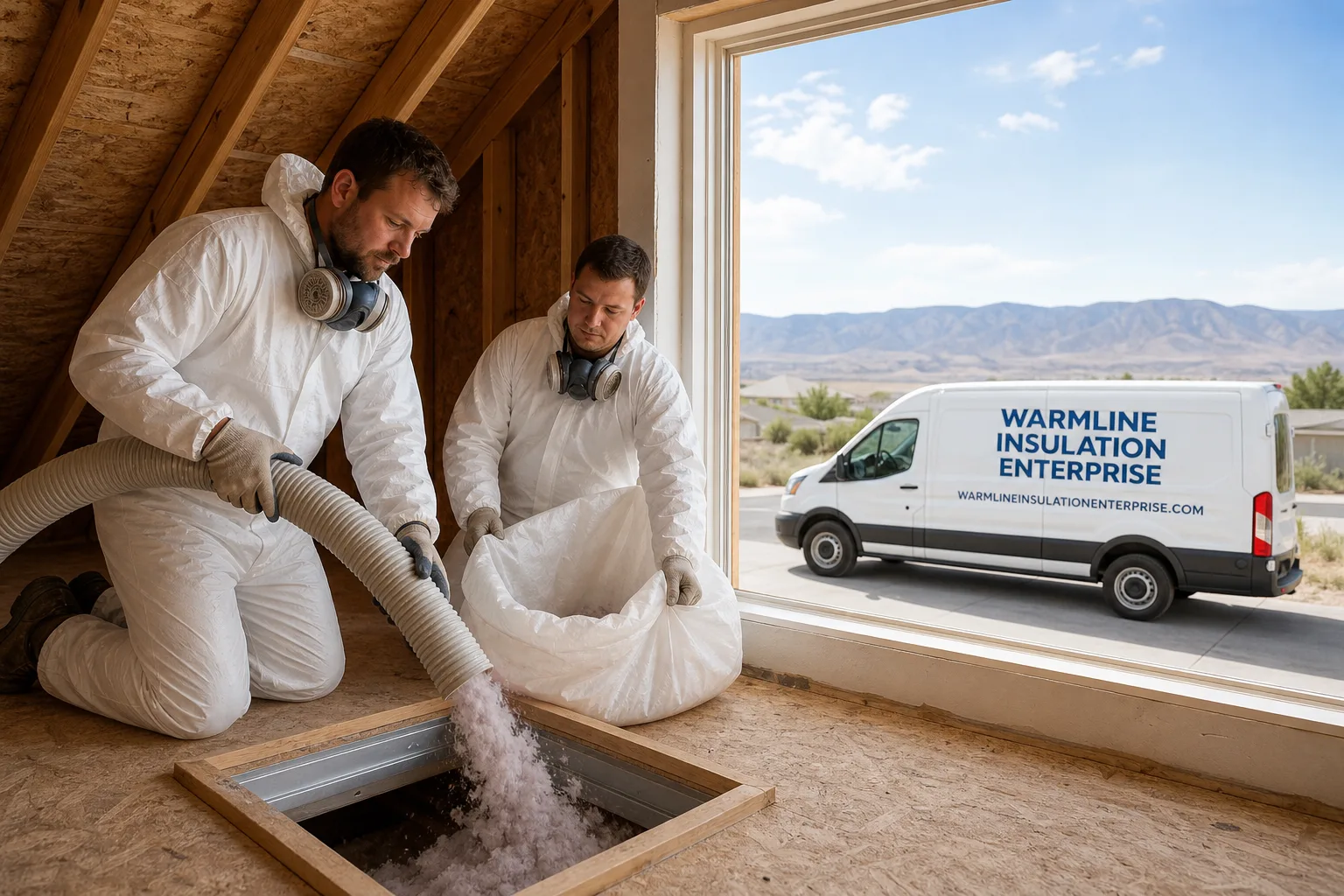
Spray Foam Insulation Cost in Enterprise, NV: What You’ll Actually Pay
Open-cell spray foam averages $1.00-$1.50 per board foot installed in Enterprise, while closed-cell runs $2.50-$3.50 per board foot. A typical 1,000-board-foot attic or rim-joist job lands somewhere between $1,100 and $3,400 depending on which type your walls and attic actually need. Which type is the real question, not just the price. Call (844) 972-1736 for a free estimate, and a live person will pick up 24/7.
Here’s what most cost guides skip. Closed-cell costs 2-3× more than open-cell, and in Enterprise’s monsoon season it’s often the only type that keeps wind-driven July rain from wicking into your stucco-on-frame wall cavity. Paying more upfront for the right foam is cheaper than paying later for trapped condensation and mold.
What Drives Spray Foam Cost in Enterprise?
Three things move the number: which foam type you choose, how many square feet of cavity get filled, and how much prep the space needs (removing old batts, sealing penetrations, cutting back failed seals). Board-foot pricing bundles coverage depth and area into one figure, which is why two houses on the same street can get quotes thousands apart.
| Application | Foam Type | Price Range (installed) |
|---|---|---|
| Rim joists (basement/crawl space) | Closed-cell | $2.50-$3.50 / board ft |
| Crawl space walls | Closed-cell | $2.50-$3.50 / board ft |
| Unvented roof deck (attic transition) | Closed-cell | $2.50-$3.50 / board ft |
| Interior walls, open cavities | Open-cell | $1.00-$1.50 / board ft |
| Attic underside (conditioned attic) | Open-cell | $1.00-$1.50 / board ft |
| Pre-job air sealing + prep | Add-on | Quoted with job |
Those ranges assume a typical 1990s-2000s Enterprise tract home. Larger or vaulted-ceiling homes and multicavity retrofits run higher.
Why Closed-Cell Wins in Enterprise’s Stucco-on-Frame Walls
Most of Enterprise is stucco-on-frame construction, and stucco is a moisture-tight exterior shell. That means any moisture that gets behind it has to dry to the inside. In a wall cavity full of absorbent fiberglass batt, that moisture sits and breeds problems.
Closed-cell foam raises the effective R-value of those wall cavities from roughly R-13 (typical 1990s batt, now often collapsed) to about R-21, and it eliminates the air-infiltration path that quietly defeats the original batt. It also acts as a Class II vapor retarder, so monsoon rain that finds a hairline crack in the stucco stops at the foam rather than soaking into the fiberglass behind it.
Open-cell foam has its place: interior walls and conditioned attics where vapor permeability isn’t a liability. But in wall assemblies exposed to July monsoon rain events, that permeability is exactly the wrong trait. We price both options honestly and tell you which one your house actually needs. That’s the whole point.
What Else Spray Foam Costs You in Enterprise Heat
South- and west-facing attics in Enterprise routinely hit 160°F in summer, and cooling load drives the energy bill far more than heating does here. That’s why spray foam’s air-sealing effect matters as much as its R-value. Sealing rim joists and roof-deck transitions keeps the 110°F-plus attic air from being pulled down into living space.
While we’re in the attic, we often find the original 1990s fiberglass batts over the garage and vaulted ceilings either collapsed, thin, or missing entirely. Filling those gaps alongside the foam is where the fastest July power-bill payback happens. It’s not always a spray-foam job; sometimes a home energy audit reveals that blown-in insulation and air sealing get you most of the way for less.
Open-Cell vs. Closed-Cell: A Quick Decision Table
- Rim joists: closed-cell (blocks air and vapor, no fiberglass to sag)
- Crawl space walls: closed-cell (handles ground moisture year-round)
- Unvented roof decks: closed-cell (prevents condensation on the deck sheathing)
- Interior partition walls: open-cell (permeability is fine, budget-friendly)
- Conditioned attic underside: open-cell (fewer board feet, good coverage)
- Exposed wall cavities with stucco exterior: closed-cell (Class II vapor retarder)
Why Warmline’s Spray Foam Pricing Holds Up Across Ten Services
Spray foam is one of ten services Warmline Insulation Enterprise handles in-house, which matters when the job is really “seal four attic penetrations, foam the rim joists, then top off the flat ceiling.” The same crew that air-seals your attic penetrations applies the foam, so nothing falls between trades. No finger-pointing. No re-dispatch next week.
Materials we install come from benchmark brands: closed-cell from Johns Manville and open-cell from Icynene, depending on the assembly. When a foam job is paired with Insulation Installation in Enterprise, the two systems are coordinated so the whole assembly performs as one, not as two contractors guessing at each other’s work.
Most spray foam jobs here complete in a single visit, with off-gassing cleared within 24 hours. We say that upfront so you can plan the day. The same backdrop applies to every service: background-checked, uniformed technicians; licensed and insured; pricing agreed before we open a single can.
And every job is covered by our 90-Day Done Right Promise. If something’s not right, we come back and make it right.
Where Spray Foam Fits Next to the Rest of Your Insulation
Spray foam is one tool, not the whole answer. For many Enterprise homes the smart, budget-aware sequence looks like this:
- Start with a free energy audit to identify the actual leak paths and where the biggest temperature gaps live.
- Air-seal the attic floor first, then decide where foam makes sense versus where blown-in covers the same gap for less.
- Spray-foam the rim joists and any moisture-exposed wall cavity with closed-cell, because those are the assemblies that punish the wrong pick.
- Top off open framing with blown-in or batts, which typically give you more R per dollar in attic floor coverage.
This is our building-science approach: don’t sell foam where fiberglass does the job, and don’t undercut a moisture-critical cavity with the cheaper foam. Our technicians have up to 15 years of experience, and the diagnostic step is where that experience pays off.
FAQs
Open-cell averages $1.00-$1.50 per board foot installed in Enterprise, and closed-cell runs $2.50-$3.50 per board foot. A 1,000-board-foot job typically lands between $1,100 and $3,400 installed depending on foam type and prep. Call (844) 972-1736 for an exact, no-pressure quote tailored to your home.
Yes, when it’s going into stucco-on-frame walls, rim joists, or unvented roof decks, where moisture tolerance matters more than price per board foot. Closed-cell acting as a Class II vapor retarder is the difference between rain drying out and rain being trapped in your wall cavity. For interior walls and conditioned attics, open-cell often gets you there for less. Call (844) 972-1736 and we’ll walk through which applies to your house.
Most spray foam jobs in Enterprise complete in a single visit, and the space is ready for normal use after off-gassing clears within 24 hours. That’s part of why we quote the whole scope upfront: no surprise return trips, no second-day install. Call (844) 972-1736 to schedule a free estimate and lock in your day.
Not if the right foam goes in the right place. Closed-cell foam in stucco-on-frame wall cavities is a Class II vapor retarder, which means monsoon rain that seeps past the stucco stops at the foam instead of soaking into absorbent fiberglass behind it. Open-cell foam in those same moisture-exposed assemblies is the version that traps water. Getting that distinction right is the whole game. Call (844) 972-1736 for a free assessment.
Get a Free Spray Foam Estimate in Enterprise Today
If your attic, walls, or crawl space are costing you every summer, we’ll give you a real number: the foam type, the board footage, and the price before we start. Free estimates, live person answering 24/7, and every job backed by the 90-Day Done Right Promise. Call (844) 972-1736 for a free spray foam estimate in Enterprise.
Written by the team at Warmline Insulation Enterprise, serving Enterprise, NV.
What Our Customers Say
"Crawl space smelled musty and the floors were cold. Full encapsulation with the thick liner taped at every seam, and a dehumidifier sized for the space. The hygrometer they left reads 48 percent now instead of the 70s."
- Elena Vasquez"Injection foam in the walls of our 1950s house, no drywall demolition, just small holes patched and painted the same day. The street noise in the front bedroom is half what it was."
- Yasmin Farah"They did the energy audit first with a blower door and thermal camera, and showed me exactly where the house was leaking before selling me anything. The fix ended up being air sealing plus a modest attic top-up, not the full replacement another company pushed."
- Grace Nakamura