
Demilec Attic Insulation in Enterprise: A Homeowner’s Guide
Enterprise summer attics regularly climb past 160°F. That’s hot enough to cook the performance out of fiberglass batts and turn loose-fill into a sagging pancake over a few seasons. Demilec closed-cell spray foam was engineered for exactly this kind of punishing heat, and it does something no batt or blown-in product can: it seals the attic as an air barrier while it insulates. Here’s what that actually means for your bills, your HVAC system, and how long your attic holds up in the Mojave climate.
If you’d rather have a specialist look at your attic than climb into 160°F heat yourself, call Warmline Insulation Co. at (844) 972-1736. Estimates are free, and a live person answers every call.
Key Takeaways
- Demilec closed-cell foam is an air barrier, vapor retarder, and structural stiffener in one application, not just an R-value number.
- Open-cell and closed-cell Demilec serve different jobs: open-cell for conditioned attics, closed-cell for unconditioned and roof-deck applications.
- Air sealing matters more than R-value alone in Enterprise because the desert heat drives air movement through every gap, not just through the insulation.
- Most attic foam jobs finish in a single visit, and the payback window in Enterprise often lands in the 4 to 7 year range depending on your starting point.
- HFO-blown Demilec has a dramatically lower global warming potential than older HFC-blown foams, a detail worth asking about.
Why Does Air Sealing Matter More Than R-Value in Enterprise?
R-value measures resistance to heat conduction. It says nothing about air leaking through the ceiling plane. In Enterprise, where attic air can hit 160°F on a July afternoon, the bigger energy loss is usually hot air pushing through gaps around recessed lights, top plates, wiring penetrations, and the attic hatch. Loose-fill and batts sit on top of those gaps and let the air move right past them.
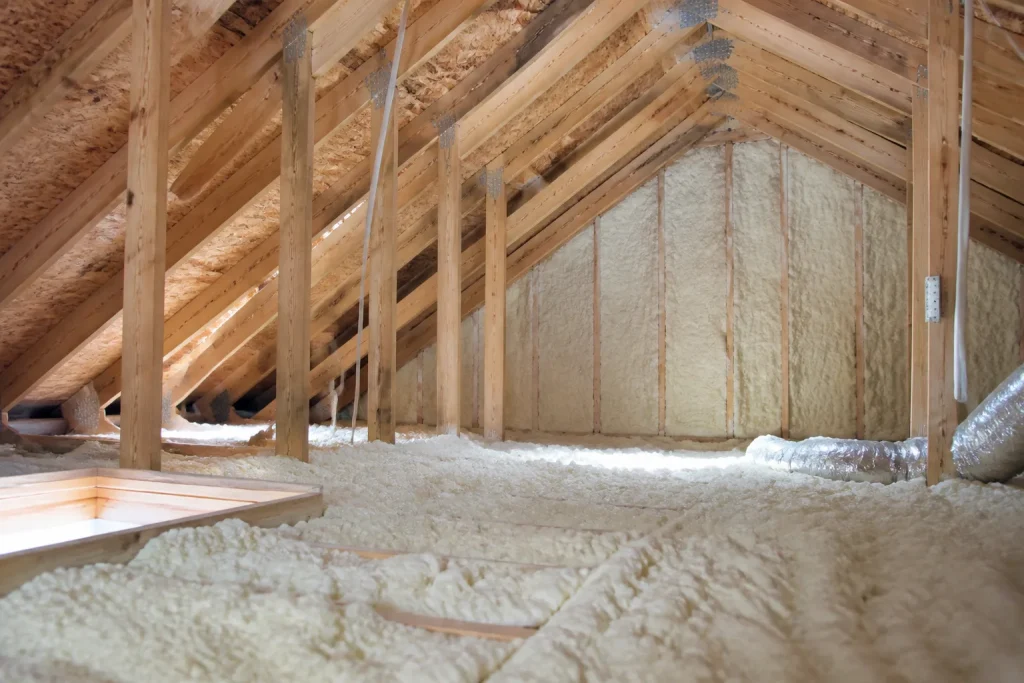
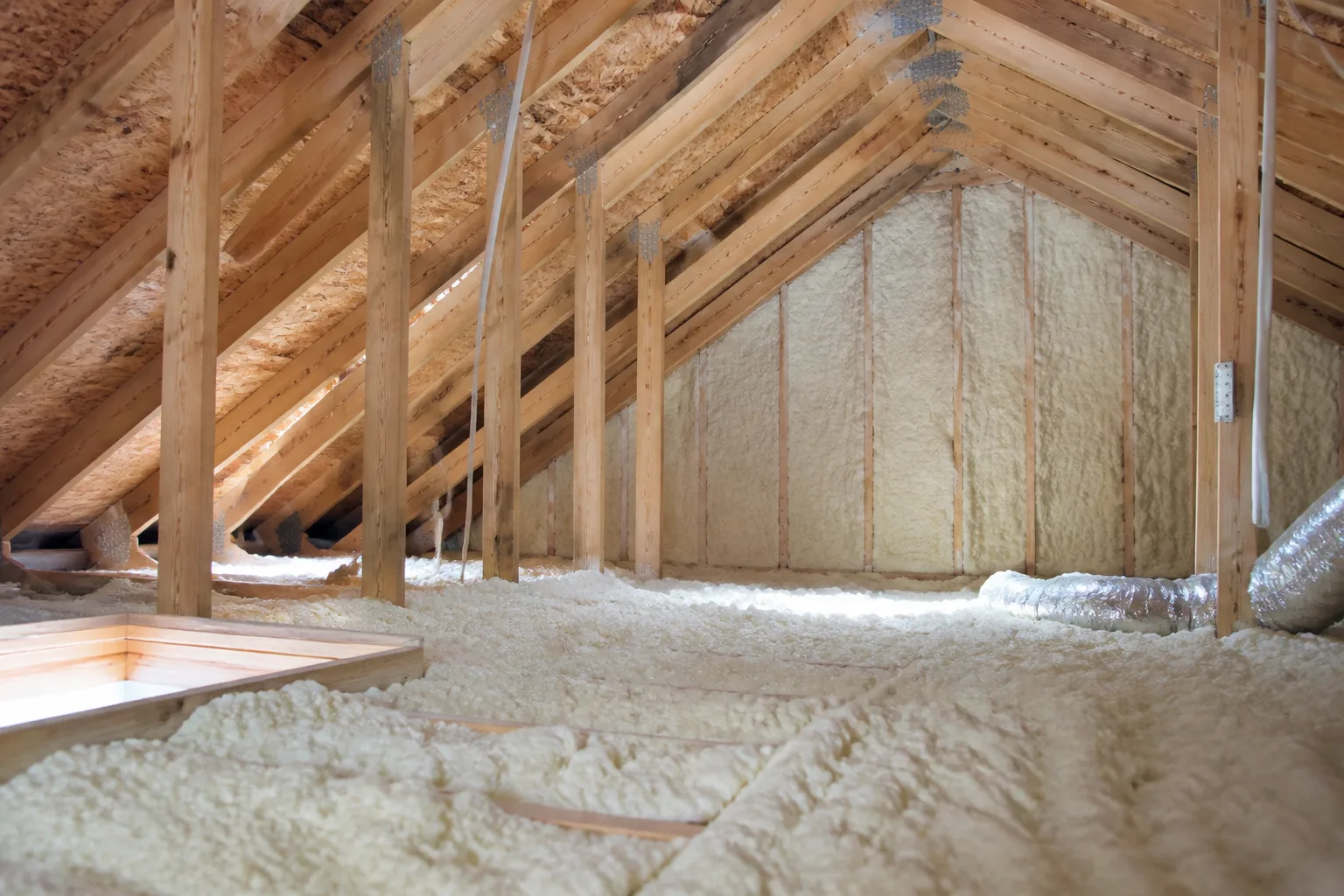
Demilec closed-cell foam expands into the gaps and cures into a continuous, air-impermeable layer. That single property is the reason it outperforms most other attic products in desert conditions. The foam doesn’t just slow conductive heat; it stops the convective loop where superheated attic air leaks into the living space and pulls cooled air out through the same holes. You can stack R-49 of fiberglass and still feel drafts if the air sealing isn’t there. We’ve walked plenty of Enterprise attics where the insulation looked thick and tidy but the top plates were wide open.
Here’s the practical difference. A batt or loose-fill job addresses one heat-transfer path. A Demilec closed-cell application addresses three: conduction, air leakage, and moisture vapor movement. That’s why we frame it as an air barrier first, insulation second. For a full breakdown of your attic options, see our guide to attic insulation in Enterprise.
Open-Cell vs. Closed-Cell Demilec: Which Is Right for Your Enterprise Attic?
The answer depends almost entirely on whether your attic is inside or outside your home’s thermal envelope. Both Demilec formulations are spray foams, but they behave very differently.
- Open-cell Demilec is lighter and more vapor-permeable. It’s the choice for a conditioned attic where the space becomes part of the building envelope and you want it to breathe slightly. It insulates well but does not act as a vapor retarder.
- Closed-cell Demilec is denser, adds structural stiffness, and acts as both an air barrier and a vapor retarder. It’s the right call for unconditioned attics and for roof-deck applications where the foam goes directly against the underside of the roof sheathing.
In the Las Vegas Valley, most homes we see in Enterprise have unconditioned vented attics. That points toward closed-cell, especially if the goal is to bring the HVAC ducts and equipment inside the envelope. If you’re converting to a sealed, conditioned attic, open-cell can be the smarter, more economical fit. The wrong choice here is the most common mistake we correct on second visits. A quick home energy audit from Warmline Insulation tells you which envelope type you’re working with before a single can of foam is opened.
How Does Demilec’s HFO Formula Compare to Older HFC Foams?
Demilec’s newer blowing agents use hydrofluoroolefins (HFOs) instead of the older hydrofluorocarbons (HFCs). The chemistry distinction sounds technical, but the environmental math is simple: HFO-blown foam has a global warming potential that’s a fraction of HFC-blown foam, often hundreds of times lower depending on the specific product. Most local contractors won’t bring this up because the older formulations are still in circulation and cost less.
For an Enterprise homeowner, this matters in three ways. First, if sustainability is on your list, you don’t have to trade performance for it. Second, HFO foams tend to have better long-term dimensional stability in high-heat environments, which is exactly what a 160°F attic demands. Third, when you compare quotes, ask each contractor which blowing agent they’re using. The answer tells you a lot about how current their material knowledge is.
We stock and specify Demilec because the formulation has held up in desert applications we’ve seen firsthand, alongside partners like Icynene and Rockwool when a different product fits the job better. If you’re weighing spray foam against other options, our spray foam insulation in Enterprise page walks through the trade-offs in more detail. The 90-Day Done Right Promise backs every application, so if the finished surface doesn’t meet the spec, we come back and make it right.
What Does a Realistic Payback Look Like in Enterprise?
Post-installation, the changes we track are HVAC runtime and attic-to-living-space temperature differential. In a typical Enterprise home with an unconditioned attic and ducts running through it, closing the ceiling plane with Demilec closed-cell foam usually cuts cooling runtime by roughly 20% to 30% during peak summer months. Duct losses drop, the second floor stops cooking, and the system cycles less. We’ve pulled readings from attics in the Riverwalk and Westwind areas where the shift was noticeable the same week.
Payback depends on your starting point. A rough ballpark for a 1,500 square foot attic in the Enterprise climate:
- Old batts or degrading loose-fill plus open air leaks: payback often lands in the 4 to 7 year range.
- Decent existing insulation but poor air sealing: payback stretches to 6 to 9 years, because the base energy loss is smaller.
- Newer home with tight construction: the financial case is weaker; the comfort and duct-lifetime case is still strong.
The right way to confirm any of this is a before-and-after energy audit, not a guess from a brochure. A blower door test and thermal imaging before and after the foam tells you exactly what changed. Enterprise homeowners dealing with high summer bills should treat the audit as the starting point. Our team runs these as part of the diagnostic before recommending any spray foam application.
Roof Deck Application: What Changes on Installation Day
Flash-and-batt (a thin layer of foam against the deck, batts below) and full-fill roof deck applications take longer than a simple flat-ceiling foam job because the crew is working overhead against angled sheathing, not a horizontal surface. A single-story Enterprise attic with an accessible deck typically finishes in one visit. Two-story homes with complex rooflines or multiple valleys can spill into a second day. We tell you which before we schedule, and most jobs still complete in a single visit.
What to clear before the crew arrives:
- Belongings stored in the attic. Foam overspray is difficult to remove from fabric and cardboard.
- Access path to the attic hatch from inside the house. Crews move equipment and hoses through it repeatedly.
- Any vehicles parked where the spray rig needs to reach the exterior hose run.
- Pets and kids kept clear of the work zone for the day; the foam cures quickly but the equipment is loud and chemicals are in play.
When to Call a Pro
Attic spray foam involves pressurized chemical systems, proper protective equipment, and precise thickness control. It’s not a weekend project, and getting it wrong in a desert climate can trap moisture or leave gaps that defeat the whole investment. If your attic hits 160°F, if you’re seeing duct condensation, if there’s any sign of roof deck moisture, get a trained professional out before you spend a dollar on insulation. We’re licensed and insured, and our technicians have up to 15 years of experience in the field.
Related services in Enterprise: if the attic work reveals moisture coming up from below, a crawl space encapsulation and vapor barrier in Enterprise may be the next step. The two systems work together.
The Bottom Line
Demilec closed-cell foam does what no batt or loose-fill product can in an Enterprise attic: it seals the ceiling plane, retards vapor, and stiffens the assembly in one application. Open-cell has its place in conditioned attics. The HFO formula is worth asking about. Payback lands in a realistic 4 to 7 year window for most homes with aging insulation. And the roof deck application timeline depends on your roofline, not on the product.
If you’re in Enterprise and want to know whether Demilec is the right fit for your attic, Warmline Insulation Enterprise offers free estimates. Call (844) 972-1736. A live person answers, 24/7. Standing offers include $50 Off Any Repair Over $250, an $89 Seasonal Tune-Up, and a permanent 5% Senior & Veteran discount.
Frequently Asked Questions
Closed-cell attic spray foam in Enterprise typically runs $1.75 to $3.25 per board foot installed, or roughly $3,500 to $7,500 for a 1,500 square foot attic depending on depth and accessibility. Open-cell runs lower. Call (844) 972-1736 for an exact quote, free of charge.
Yes. In an unconditioned Enterprise attic, closing the ceiling plane with closed-cell foam usually cuts cooling runtime by 20% to 30% during peak summer. Real savings depend on your starting condition, which a home energy audit confirms.
That depends on what’s failing. Degraded loose-fill with open air leaks is often better replaced with foam than patched. Intact batts with air sealing gaps may just need sealing and top-off. A free assessment from Warmline tells you which path is cheaper for your Enterprise home. Call (844) 972-1736.
We schedule free estimates quickly, and most Demilec jobs complete in a single visit. Call (844) 972-1736 to check next availability; a live person answers 24/7.
Written by the team at Warmline Insulation Enterprise.
Need Insulation Help?
Call Warmline Insulation Enterprise - licensed & insured, here with fast after-hours help in Enterprise.
(844) 972-1736