
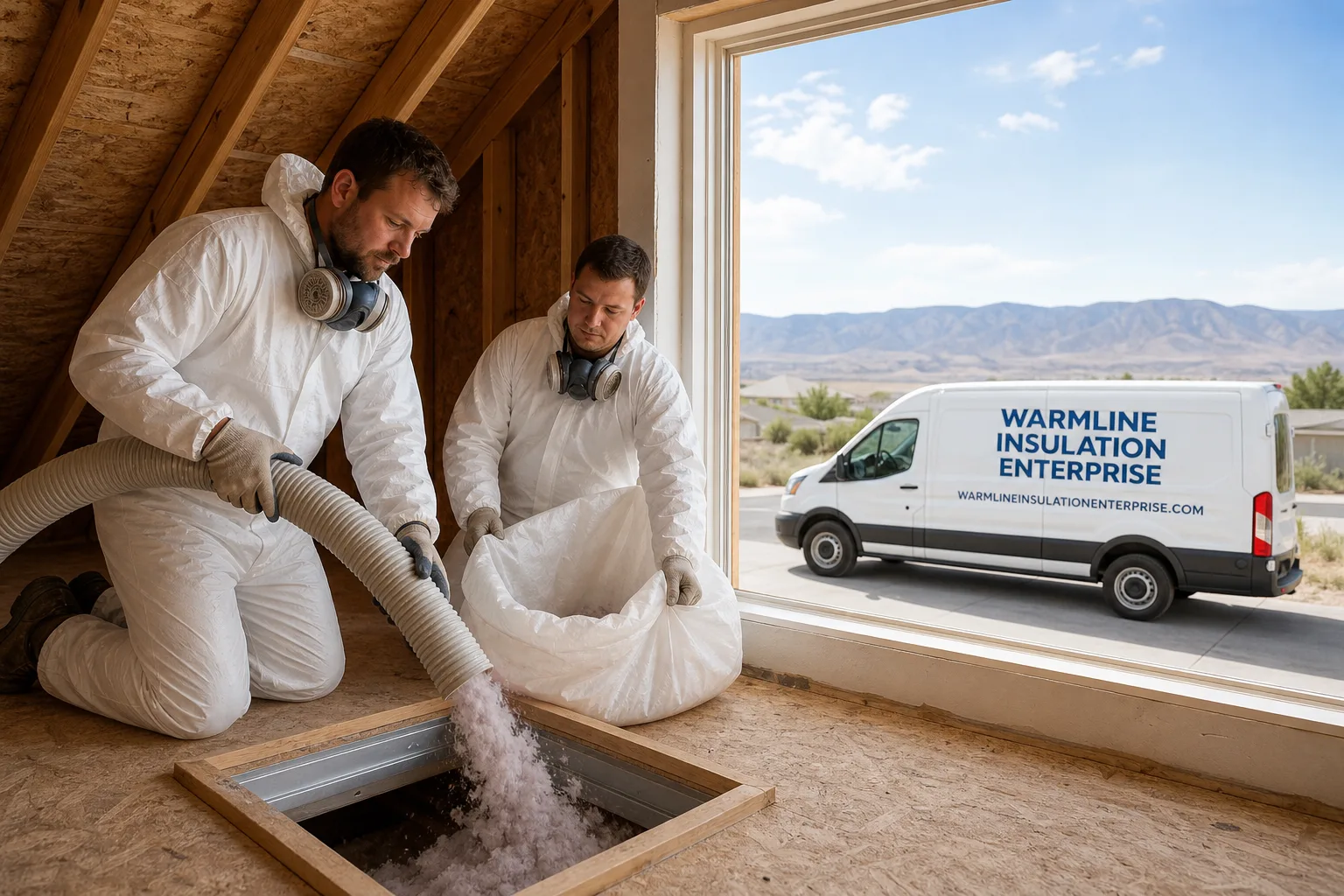
Fast, Reliable Blown-In Insulation Across Whitney
If your Whitney home runs hot in July and you can’t figure out why the upstairs and the rooms over the garage always feel worse than the rest, the insulation is usually the first place to look. Whitney is unincorporated Clark County, not the City of Las Vegas, and the housing here is mostly post-1990s stucco-on-frame subdivision construction in 89122, plus pockets of older manufactured homes that were never built for a Mojave summer. We know this area and its housing stock well, and we can usually get a crew out to Whitney within a day or two of your call. Call (844) 972-1736 and a live person will pick up, day or night.
Why Warmline Insulation Enterprise Is Whitney’s Preferred Blown-In Insulation Company
Whitney homeowners call us because we treat insulation as the foundation of a comfortable house, not an afterthought tacked onto a bigger remodel. Our technicians have up to 15 years of experience, they’re background-checked and uniformed, and they show up understanding the specific problems that show up in 89122 tract homes. That matters more than a generic pitch.
We’re licensed and insured, and every job carries our 90-Day Done Right Promise: if the work isn’t right, we come back and make it right. That written commitment is something most contractors won’t put on paper. We also answer the phone with a live person 24/7, so when you call about a hot attic in the middle of a July heat wave, you’re not leaving a voicemail and waiting.
And when you call, you get upfront pricing before any work starts. Most blown-in jobs are finished in a single visit, which means one crew, one day, and no juggling schedules across multiple trades. That’s the reputation we’ve built with Whitney customers who’ve had us out for attic work and then called back for a second service.
Our Blown-In Insulation Services in Whitney
Blown-in insulation isn’t one product; it’s a family of approaches, and the right one for your Whitney home depends on what’s in your attic now and what’s failing. Here’s how we handle the four most common requests in 89122.
Blown-In Fiberglass
Fiberglass blown-in is our most common Whitney attic choice because it performs well in a dry, baking truss attic. In a post-1990s subdivision where the builder installed R-19 batt, we often blow fiberglass over the existing field to reach a higher settled R-value, using GreenFiber or CertainTeed material that holds its loft under UV exposure. Because Whitney’s single-digit humidity means the attic never wets out, the material degrades by thinning and UV-cooking rather than by moisture, so a high-R fiberglass top-up is the right answer more often than a vapor-barrier retrofit.
Blown-In Top-Up
A top-up means adding insulation over what’s already there, and in Whitney’s tract homes it’s usually the fastest path to a real comfort improvement. We measure the existing depth first, then calculate how much material it takes to hit your target R-value, and we air-seal before we blow so the new insulation sits on a sealed ceiling plane instead of a leaky one. Reach out to our Blown-In Insulation team if you’re unsure whether your attic is a top-up candidate or needs a full replacement.
Dense-Pack Wall Insulation
Dense-pack wall insulation is the fix for Whitney’s stucco-on-frame subdivisions where exterior walls were left under-insulated or with voids around windows and doors. We drill small holes from the interior or exterior depending on the wall assembly, blow material in at a density that resists settling, and patch clean. This is especially useful on sun-baked west and south walls where a few missing inches of insulation translate directly into a hot room.
Blown-In Cellulose
Cellulose is a good choice when you want a material with better airflow resistance and sound dampening, and it performs well in Whitney’s dry attic conditions. We use it for both open-blow attic applications and dense-pack walls, and we always confirm it’s the right fit for your settled depth target before quoting. Cellulose is denser than fiberglass, so on some Whitney attics it reaches the target R-value with less material depth.
Trusted Brands We Service in Whitney
We work with the insulation industry’s benchmark manufacturers, including CertainTeed, GreenFiber, Owens Corning, and Johns Manville. Those names matter because the material spec is what a Whitney job gets judged on. Unlike wetter climates where moisture control drives the decision, in 89122 it’s settled depth and material performance under 150°F-plus attic temps that determine whether your home actually cools. We do not stock parts or material for pickup; every job is quoted and scheduled, and turnaround is fast. Most Whitney blown-in jobs get scheduled within a couple of days of your estimate.
Common Blown-In Insulation Problems We See in Whitney Homes
These are the four issues that come up again and again in Whitney’s post-1990s tracts and older manufactured units, and each one explains a specific comfort complaint we hear from homeowners in 89122.
- Builder-grade R-19 batt thins over the garage-to-house transition. In Whitney Ranch-era homes, the fiberglass batt that was installed at build settles and compresses in the transition zone, leaving the rooms over the garage under-insulated. That’s why those rooms run 5-8°F hotter than the rest of the house on a July afternoon.
- Recessed can lights and top plates go unsealed. Every can light punches an unsealed hole in the ceiling plane, and top plates often leak too. When blown-in is installed on top of those leaks, hot attic air channels straight down into the living space and the new insulation can’t do its job.
- UV-cooked and settled fiberglass loses effective R-value. A 150°F-plus truss attic under Mojave sun degrades fiberglass over time, so material that measured R-19 at installation may perform like R-13 a decade or two later. A straight top-up without air sealing or a radiant barrier leaves the problem half-fixed.
- Radiant heat gain goes untouched. Whitney’s real enemy is radiant heat, not moisture. Without a radiant barrier under the roof deck, the blown-in insulation slows conducted heat but does nothing for the radiant load that bakes the attic in the first place.
Pricing for Blown-In Insulation in Whitney, NV
Here’s what blown-in work actually runs in Whitney’s market, so you can plan instead of guess. A typical blown-in fiberglass or cellulose attic top-up in Whitney runs $1,400 to $3,200 for an average 1,500-2,000 sq ft home, depending on target R-value and existing depth. Dense-pack wall insulation typically lands between $2.50 and $4.50 per square foot of wall area, and adding a radiant barrier under the roof deck usually adds $1,200 to $2,500. Attic air sealing before the blow is often bundled into the top-up price but adds $400 to $900 if quoted separately. The biggest cost driver is the gap between your current R-value and the target R-value, followed by attic access and the amount of air sealing needed. We give free estimates in Whitney with upfront pricing, no surprises, and most jobs are completed in a single visit.
We Also Serve Cities Near Whitney
From Whitney we regularly handle work in Sunrise Manor to the north, Winchester and Paradise to the west toward the Strip, and neighborhoods throughout Las Vegas. The 89122 construction styles and the radiant-heat problems that come with them show up across those areas too, so the crew that knows your Whitney attic knows the neighboring ones. You can learn more about our Blown-In Insulation in Whitney coverage and how we schedule jobs in this corner of the valley.
Serving Whitney, NV – Our Local Coverage Area
We serve Whitney and nearby communities. Use the map below to see the area we cover. If you’re nearby, we can almost certainly help.
FAQs – Blown-In Insulation in Whitney
A blown-in top-up alone usually isn’t enough in Whitney’s post-1990s tracts; you generally want both a high-R top-up and a radiant barrier. The batt in these homes has thinned and UV-degraded over the garage-to-house transition, and a top-up fixes the conducted heat loss but not the radiant load baking the attic. Pairing the two is what actually drops the temperature in the hottest rooms. Call (844) 972-1736 for a free estimate on both.
The garage-to-house transition is the single most common insulation gap we find in Whitney homes. Builder-grade batt gets compressed thin or blown out in that zone, and the ceiling over the garage was battted to less than the rest of the attic. Combined with unsealed can lights and top plates, it creates a channel for hot attic air to drop straight into those rooms. An air-seal plus high-R blown-in usually fixes it in a single visit. Call (844) 972-1736 for a free attic check.
Yes, in most Whitney attics a vapor barrier retrofit isn’t needed. With single-digit humidity and almost no attic moisture load, the failure mode here is UV-degraded and settled fiberglass and radiant heat gain, not damp insulation. Venting and vapor barriers belong to wetter climates. Your money in Whitney is better spent on air sealing, a high-R top-up, and a radiant barrier. Call (844) 972-1736 and we’ll confirm what your attic actually needs.
We target R-38 to R-49 for Whitney attics, with R-49 the typical recommendation for a post-1990s tract home fighting 105°F-plus summer highs. Reaching that usually means a substantial top-up over existing R-19 batt, and often some dense-pack work on west and south walls where builder insulation was thin. Getting to the target R-value matters more than the material brand, though we use CertainTeed and GreenFiber because they hold their loft under UV exposure. Call (844) 972-1736 for a free R-value check.
Yes, dense-pack is one of our most common Whitney wall jobs. Stucco-on-frame builds in 89122 often have voids or under-insulated exterior walls, and dense-pack fills them without disturbing the stucco when we drill from the interior. On sun-baked west and south walls it’s one of the highest-return upgrades you can make. Call (844) 972-1736 for a free estimate.
Get Your Whitney Attic Checked Before Summer
Stop losing money through your attic. Whether your Whitney home needs a simple top-up, a full radiant-barrier and high-R package, or dense-pack walls, we’ll diagnose it, quote it upfront, and finish most jobs in a single visit. Every job is backed by our 90-Day Done Right Promise, and our phones are answered by a live person 24/7. Call (844) 972-1736 for a free estimate and find out what’s really happening in your attic.
Written by the team at Warmline Insulation Enterprise.