
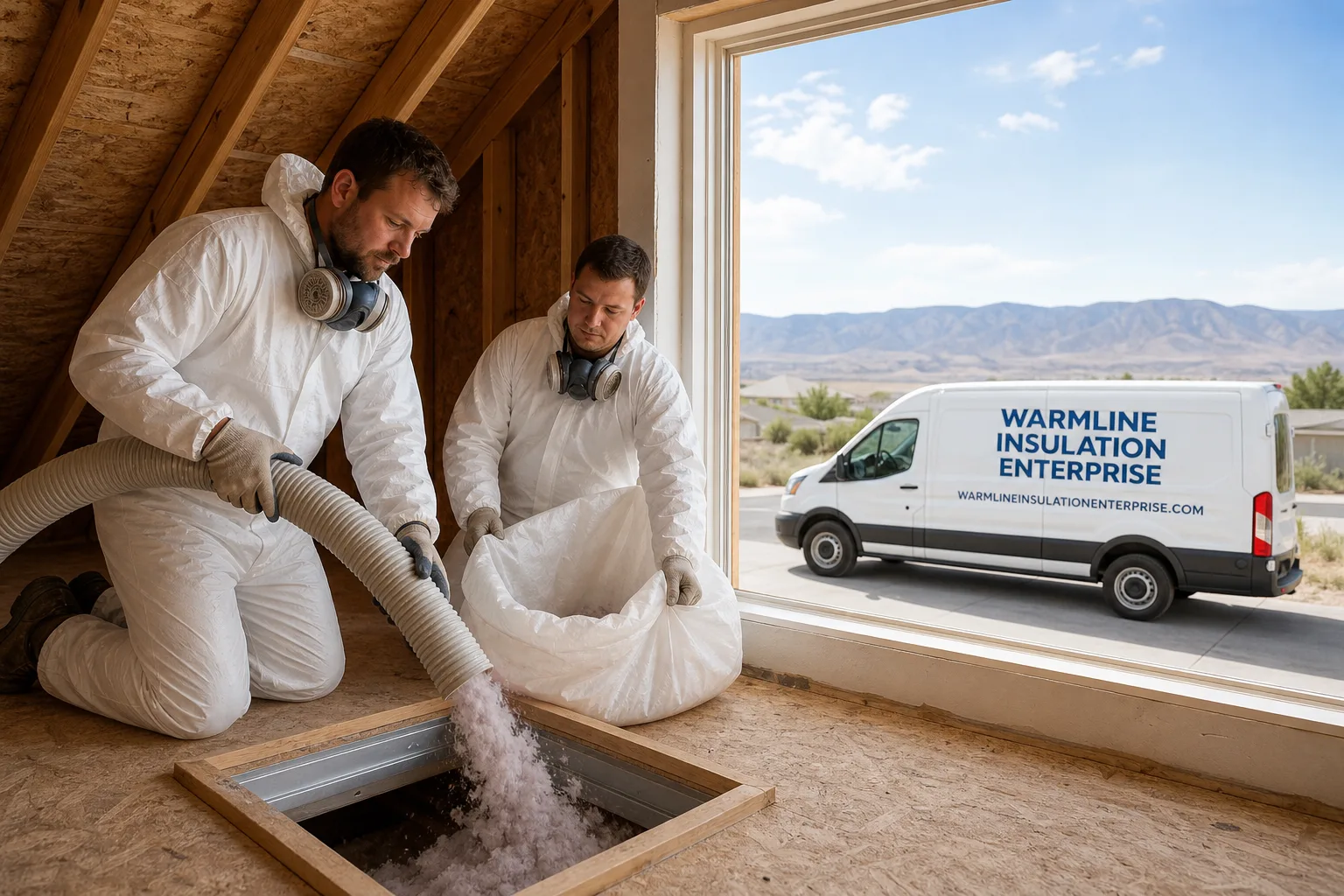
How Much Does Wall Insulation Cost in Enterprise?
Wall insulation in Enterprise, NV typically costs $1.60 to $3.50 per square foot for blown-in or injection-foam retrofits of existing walls, which puts most single-family homes between $2,400 and $6,800 for a whole-house job. Partial wall coverage on one or two problem walls usually runs $700 to $1,900. Spray foam commands the higher end of that range, while dense-pack fiberglass and cellulose sit closer to the middle.
Enterprise homeowners call us most often in late spring and early October, when the desert swings from 40°F nights to 95°F afternoons inside a week. Walls that were never properly insulated make those swings impossible to manage, and your HVAC ends up working overtime to chase a temperature it can’t hold. Here’s what the work actually costs in the Enterprise market this year, and what moves the number up or down.
Key Takeaways
- Whole-house wall insulation in Enterprise runs $2,400 to $6,800 for most homes; single-wall retrofits start around $700.
- Dense-pack blown-in (fiberglass or cellulose) is the workhorse option: $1.60 to $2.60 per sq ft.
- Spray foam delivers the highest R-value per inch but costs $2.50 to $3.50 per sq ft.
- Uninsulated exterior walls in Enterprise homes built before 1995 are common, and that’s the single biggest driver of high summer bills.
- Free estimates with upfront pricing, and most jobs are completed in a single visit.
Wall Insulation Cost Breakdown (2026)
The table below reflects real pricing for the Enterprise market as of 2026. Your exact job depends on wall access, the material you choose, and how much of the home we’re covering.
| Scope of Work | Typical Cost Range |
|---|---|
| Single-wall retrofit (one exterior wall, dense-pack fiberglass) | $700 – $1,100 |
| Single-wall retrofit (one exterior wall, spray foam) | $950 – $1,500 |
| Dense-pack blown-in fiberglass or cellulose (whole house) | $1.60 – $2.60 / sq ft |
| Spray foam injection, existing walls (whole house) | $2.50 – $3.50 / sq ft |
| Two-story home wall insulation (larger wall area) | $3,800 – $7,500 |
| Wall insulation combined with attic air sealing | $2,900 – $7,800 |
| Drywall repair/patch after injection holes (per wall) | $150 – $450 |
| Home energy audit (diagnostic that scopes the work) | $250 – $450 |
The biggest cost driver in Enterprise is wall access. In a rough-open new-construction scenario, wall insulation is straightforward. In a finished Enterprise home – which is most of the housing stock – we’re doing injection retrofits: cutting small holes in the drywall or drilling from the exterior, blowing dense-pack material or foam into the stud bays, then plugging and patching. That process is slower and more careful, which is why a finished-wall job costs more per square foot than the same R-value in a wall that’s already open.
The second driver is material choice. Dense-pack fiberglass and cellulose are the budget-friendly workhorses and perform well in our climate. Spray foam costs more but seals air gaps and frames at the same time, which matters in Enterprise because wind-driven dust and desert heat find every unsealed seam. We install products from Owens Corning, Rockwool, CertainTeed, Icynene, Demilec, Johns Manville, Knauf, and GreenFiber, and we’ll walk you through which material actually fits your walls rather than pushing the most expensive one. A wall insulation plan built on solid R-values and careful air sealing gives you more comfort per dollar than an oversized foam job that skips the detailing.
If you want the full context on how we approach these retrofits, our Wall Insulation in Enterprise page covers the process step by step, and the home page has the full menu of services we provide.
What Affects Wall Insulation Pricing in Enterprise
- Home age and wall construction. Enterprise has a mix of mid-century builds and 2000s-era subdivisions. Homes built before the mid-1990s frequently have little to no insulation in exterior walls – or insulation that has sagged and settled over decades of desert heat cycling. Those walls need the full dense-pack treatment, while newer homes may only need partial work on sun-facing walls.
- Wall access and finish type. Stucco exteriors, common across Enterprise, require drilling from the outside with careful patching and color-matching. Interior drywall access means small holes with interior repair. Each affects labor, and therefore price.
- Number of exterior walls. A simple rectangle has fewer walls to treat than an L-shaped or multi-gable plan. Sun-exposed walls on the west and south sides are the priority in our climate; we’ll often recommend starting with the walls that get hammered most.
- Insulation material and R-value target. Wall R-value needs vary by wall type and how your home is built. In Nevada’s hot climate, many walls target R-13 to R-15 minimum, and going higher costs more in material and cavity depth. We’ll recommend the R-value that balances cost against real energy savings in your home.
- Combining work with air sealing or attic insulation. Wall work is more cost-effective when bundled with attic air sealing, since the crews and access are already in place. Many Enterprise homeowners pair the two to fix both the walls and the ceiling plane at once.
- Site conditions. Crawl space access, attic height, landscaping close to walls, and HVAC or plumbing inside wall cavities all add time. We’ll scope these during the free estimate so there are no surprise line items later.
How to Save on Wall Insulation
There’s no way around the fact that a good wall job costs money. But there are real ways to reduce what you spend without cutting quality:
- Start with a home energy audit. Before you insulate every wall, find out which ones are actually costing you money. Our audit pinpoints where the heat is getting in and where air leaks live, so you can put your budget toward the walls that matter most. A targeted job on two problem walls often delivers most of the comfort benefit for a fraction of a whole-house cost.
- Bundle with air sealing and attic work. Wall insulation paired with attic air sealing and attic insulation creates a full thermal envelope. Bundling reduces total labor, and it’s cheaper than bringing crews out twice.
- Choose dense-pack over spray foam where it fits. If your walls have standard stud bays and no complicated framing, dense-pack fiberglass or cellulose performs reliably in our climate and costs less than foam. We’ll tell you honestly whether foam’s extra sealing is worth it for your specific walls.
- Ask about the standing offers. We keep our pricing upfront and simple, and three offers are always available: $50 off any repair over $250, an $89 seasonal tune-up, and a permanent 5% Senior & Veteran discount. Seniors and veterans should just ask when they book – it applies to the whole job.
- Get a free estimate before you commit. Call (844) 972-1736 and a live person will pick up, 24/7 – no voicemail, no answering service. We’ll give you a straight number for your home, in writing, with no surprises.
Most wall insulation jobs in Enterprise are completed in a single visit, so you’re not juggling schedules or dealing with open walls for a week. Your home goes back to normal the same day. Every job is backed by our 90-Day Done Right Promise: if it’s not done right, we make it right. That’s a written commitment, not a handshake.
Why Wall Insulation Costs What It Does in Enterprise
It’s worth understanding what you’re actually paying for, because wall insulation isn’t a fixed commodity. The price reflects three things: material volume, careful retrofit labor, and the detailing that makes insulation perform.
Material and R-Value
Every wall has to hit a target R-value, and the material you choose determines both the cost and the performance. Dense-pack cellulose and fiberglass are cost-effective and block air movement reasonably well. Spray foam delivers the highest R-value per inch and seals gaps as it expands, which matters in Enterprise because our dust and wind will exploit every unsealed seam. We stock trusted brands – Owens Corning, Rockwool, CertainTeed, Icynene, Demilec, Johns Manville, Knauf, and GreenFiber – so you’re not paying a premium for a material that fails in five years.
Labor and the Retrofit Process
Installing wall insulation in a finished home requires an experienced crew. We drill small holes, inject material at the right density, and seal and patch carefully so the wall looks untouched. Our technicians have up to 15 years of experience, and they’re background-checked and uniformed on every job. That experience is why we can usually complete a whole-house wall retrofit in a single visit without cutting corners on the detailing.
Diagnostics and Whole-House Planning
Wall insulation done in isolation can disappoint. The walls are one part of a system that includes the attic, the ceiling plane, and air sealing. Before recommending any wall work, we look at the whole house. If you have unsealed attic penetrations or a leaky crawl space, the money spent on walls won’t deliver the savings you expect. Our home energy audit is the diagnostic starting point that makes the wall insulation plan smarter and more targeted, and it’s often what separates a job that pays back from one that doesn’t.
Is Wall Insulation Worth the Cost in Enterprise?
In most Enterprise homes, yes, and quickly. A single uninsulated exterior wall on the sun side can push your cooling load up dramatically during June through September. When we insulate those walls and seal the air gaps, homeowners tell us they feel the difference the same day – rooms that used to swing wildly now hold a steady temperature.
Payback depends on your starting point. A home with no wall insulation is likely to see the strongest return, often recouping the investment through lower energy bills within a few years. A newer home with partial insulation may see a longer return, but the comfort gain is usually the bigger reason people do it. We’ll give you an honest read on what to expect for your home during the free estimate, and we won’t oversell a job your home doesn’t need.
Wall Insulation vs. Other Upgrades in Enterprise
Wall insulation is one of the highest-impact upgrades in our climate, but it works best as part of a full thermal plan. If you’re comparing options, here’s how it stacks up against related work.
- Wall insulation vs. attic insulation. Attic insulation often gives the biggest bang for the buck because heat rises. Wall insulation fixes the walls the sun bakes directly. In Enterprise, we frequently recommend both, and pairing them saves labor.
- Wall insulation vs. air sealing. Air sealing stops the leaks that insulation can’t fix on its own. For a drafty home, sealing first and insulating second is the smarter order, and we’ll plan for it.
- Wall insulation vs. radiant barriers. A radiant barrier in the attic reduces heat gain through the roof. It’s a strong complement to wall insulation in our climate, and we’ll tell you whether your attic is a good candidate.
Because we handle all ten insulation and home-performance services under one contractor, you don’t get handed off between trades. One crew, one plan, one point of accountability for the whole envelope.
Signs Your Enterprise Home Needs Wall Insulation
Wondering whether your walls are the problem? Here’s what we look for when we visit Enterprise homes.
- Walls that feel hot to the touch on the inside during summer afternoons.
- Rooms that swing from cold to hot within a day, especially sun-facing rooms.
- Higher-than-expected energy bills with no obvious cause.
- Drafty outlets, switches, and baseboards on exterior walls.
- An older home where you can’t tell whether walls were ever insulated.
- Dust accumulating quickly on wall surfaces, which can point to air movement through gaps.
None of these are emergencies, but each one is a clue. If two or more sound familiar, an energy audit is the fastest way to confirm the cause before you spend anything.
What to Expect From the Wall Insulation Process
We keep the process simple and clean. Here’s how a typical Enterprise wall insulation job runs:
- Free estimate. We take measurements, inspect wall access, and give you upfront pricing with no surprises.
- Energy audit (recommended). We diagnose where heat and air are actually getting in, so the plan targets the right walls.
- Prep and protection. We protect floors and furnishings, and set up so the workspace is contained.
- Injection and sealing. We drill small holes, blow in dense-pack material or foam, and seal every penetration carefully.
- Patch and clean-up. We patch and finish access points and leave the space ready to live in.
- Final walkthrough. We show you what was done, confirm the coverage, and back the work with our 90-Day Done Right Promise.
Most jobs are completed in a single visit. Calls are answered by a live person 24/7, so you can start the process whenever it suits you, and technicians are background-checked and uniformed when they arrive.
FAQs – Wall Insulation Cost in Enterprise
How much does wall insulation cost in Enterprise, NV in 2026?
Whole-house wall insulation in Enterprise typically costs $2,400 to $6,800, and single-wall retrofits run $700 to $1,900. Dense-pack blown-in is the budget-friendly workhorse at $1.60 to $2.60 per square foot, while spray foam runs $2.50 to $3.50 per square foot. Call (844) 972-1736 for an exact quote – estimates are free.
Is it cheaper to insulate just the walls or the whole house?
Insulating just two or three problem walls usually costs $700 to $1,900, versus $2,400 to $6,800 for a whole-house job. The targeted approach is cheaper up front, but if your attic and walls are both leaking, treating one without the other often leaves savings on the table. Call (844) 972-1736 and we’ll tell you honestly which approach fits your home.
How much does wall insulation cost per square foot in Enterprise?
Dense-pack fiberglass or cellulose runs $1.60 to $2.60 per square foot, and spray foam runs $2.50 to $3.50 per square foot. Total cost depends on how many exterior wall square feet you have and whether patching is included. Call (844) 972-1736 for a measured quote – estimates are free.
Can you insulate existing walls without tearing out the drywall?
Yes. In most finished Enterprise homes, we use injection methods – small holes drilled from the interior or exterior, material blown in, then holes sealed and patched. It takes a single visit for most jobs, and drywall repair is included in the quote. Call (844) 972-1736 to schedule.
Will wall insulation pay for itself in Enterprise?
Homes with no wall insulation often see the strongest return, potentially recouping the investment through lower energy bills within a few years. Newer homes with partial insulation may take longer to pay back, though the comfort gain is immediate. Call (844) 972-1736 for a free estimate and an honest payback read for your home.
Ready for a Straight Answer on Your Wall Insulation Cost?
If your Enterprise home is drafty, hot on one side, and fighting your thermostat, wall insulation is one of the highest-impact upgrades you can make. Warmline Insulation Co. has been serving local communities since 2011, and our technicians bring up to 15 years of experience to every job. We’re licensed and insured, we answer calls with a live person 24/7, and we stand behind every job with our 90-Day Done Right Promise. Get a free estimate with upfront pricing – no surprises, most jobs done in a single visit – by calling (844) 972-1736 today.
Pricing reflects the Enterprise market as of 2026. Warmline Insulation Enterprise offers free estimates – call (844) 972-1736.
What Our Customers Say
"Crawl space smelled musty and the floors were cold. Full encapsulation with the thick liner taped at every seam, and a dehumidifier sized for the space. The hygrometer they left reads 48 percent now instead of the 70s."
- Elena Vasquez"Injection foam in the walls of our 1950s house, no drywall demolition, just small holes patched and painted the same day. The street noise in the front bedroom is half what it was."
- Yasmin Farah"They did the energy audit first with a blower door and thermal camera, and showed me exactly where the house was leaking before selling me anything. The fix ended up being air sealing plus a modest attic top-up, not the full replacement another company pushed."
- Grace Nakamura